HUTB Holds Launch Meeting for Undergraduate Education Teaching Audit and Evaluation
2025-11-10
On the morning of November 10, the university held the Launch Meeting for the Undergraduate Education Teaching Audit and Evaluation in the Zhizhi Lecture Hall of Xiangjiang Building. Attending the meeting were Academician Chen Xiaohong, Secretary of the CPC HUTB Committee and Director of Xiangjiang Laboratory; Lan Yong, Member of the CPC Leading Group and Deputy Director of the Department of Education of Hunan Province; and Wang Qiao, Leader of the Audit and Evaluation Expert Panel for Undergraduate Education and Teaching, and former Secretary of the CPC Committee of Jiangxi University of Finance and Economics. All members of the expert panel, all Chief Leaders, members of the CPC HUTB Committee, and relevant personnel participated in the meeting through a combination of online and offline channels.
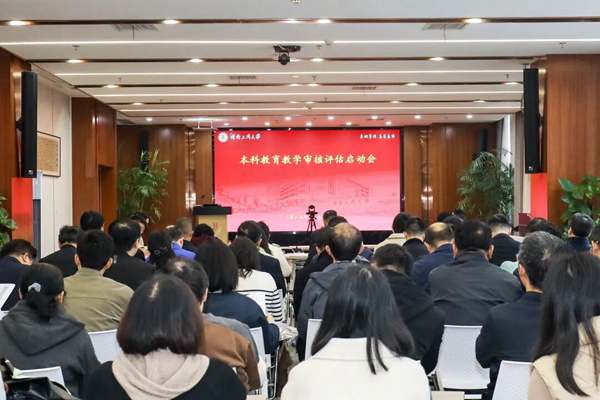
The meeting was conducted in two stages. The first stage was chaired by Liao Xiangyue, Deputy Secretary of the CPC HUTB Committee and President of HUTB, while the second stage was presided over by Wang Qiao, Leader of the Evaluation Expert Panel. Zhang Ling, Vice President of HUTB, introduced the attending leaders and members of the expert panel at the meeting.
Academician Chen Xiaohong, Secretary of the CPC HUTB Committee and Director of Xiangjiang Laboratory, delivered a speech at the meeting. She stated that HUTB has always adhered to its original mission of "cultivating talents for the Party and the country," fully implemented the fundamental task of fostering virtue and nurturing talents, established a "three-wide education" (all-round, whole-process, and all-person education) framework, and continuously deepened education and teaching reforms based on comprehensive interdisciplinary integration and the optimization of disciplines and majors. The new round of undergraduate education teaching audit and evaluation is not only a comprehensive inspection of the university's talent cultivation work but also an important opportunity to summarize experiences, address shortcomings, promote connotative development, enhance governance capabilities, and consolidate developmental advantages. The university will adhere to the principle of "promoting construction, reform, management, and enhancement through evaluation," fully present the actual situation of education and teaching, sincerely listen to expert opinions, formulate solid rectification plans for identified issues, continuously improve the quality assurance system, accelerate the construction of an innovative first-class university, and contribute wisdom and strength to realizing Hunan's "Three Highlands, Four New Missions" vision and advancing the construction of an education powerhouse and Chinese modernization.
Lan Yong, Member of the CPC Leading Group and Deputy Director of the Department of Education of Hunan Province, delivered a speech at the meeting. He emphasized that conducting the undergraduate education teaching audit and evaluation is a crucial measure for thoroughly implementing the spirit of the central government's education evaluation reform and the national and provincial education conferences. It serves as an important pathway to accelerate the establishment of a higher education quality assurance system with Chinese characteristics and meets the urgent need for promoting high-quality development in higher education. He put forward three hopes and requirements for the university: first, enhance perspective and correctly understand the importance of the evaluation; second, focus on development and jointly deepen the evaluation; third, maintain discipline and fully cooperate to support the evaluation. He also expressed hope that the expert panel would offer guidance and valuable suggestions for higher education teaching in Hunan, particularly providing constructive feedback on the undergraduate education teaching audit and evaluation at HUTB.
Wang Qiao, Leader of the Expert Panel and former Secretary of the CPC Committee of Jiangxi University of Finance and Economics, elaborated on the objectives of the undergraduate education teaching audit and evaluation. He emphasized that the new round of evaluation adheres to the fundamental task of fostering virtue through education and aims to enhance the quality of undergraduate education and teaching. He provided four key explanations regarding the audit and evaluation process: first, accurately grasp the connotation of the evaluation; second, implement key tasks of the online assessment; third, arrange on-site assessment activities; fourth, clarify work discipline requirements for the expert panel. He expressed hope that all faculty, staff, and students would collaborate with the expert panel to transform the evaluation process into a powerful driving force for building consensus and promoting development, thereby injecting new momentum into the university’s growth and progress.
Liao Xiangyue, Deputy Secretary of the CPC HUTB Committee and President of HUTB, delivered a supplementary report titled "Integrated Education and Innovation: HUTB's Practices in High-Quality Undergraduate Education Development." He stated that the university would welcome the inspection by experts from the Ministry of Education with full enthusiasm, solid work, and outstanding achievements. He emphasized that the university would seize the opportunity of this audit and evaluation to strive to create a new pattern of high-quality development in undergraduate education and teaching.
According to reports, the evaluation will commence on November 10 and continue until December 3. In accordance with the implementation plan requirements and evaluation procedures, during the online assessment phase, the expert panel will focus on comprehensively reviewing the university's evaluation materials while simultaneously conducting online class observations and holding forums and interviews with Chief Leaders, administrative staff, teachers, and students. The panel will then collate and summarize issues to form a list of key points for the on-site campus evaluation. During the offline assessment phase, the expert panel will conduct verification through field inspections, on-site investigations, and reviews of original materials.
(Written by Zhang Gaoyang and Yang Shuilin and photo by Tu Hua)