Professor Wu Xiaolin of Zhou Enlai School of Government, Nankai University, Came to Give a Lecture
2019-02-22
On the evening of November 20, Professor Wu Xiaolin, doctoral supervisor of Zhou Enlai School of Government, Nankai University, was invited to HNUC to give a lecture on “Forty years of Chinese Urban Community Governance”. The lecture was hosted by Professor Wu Hongxing of School of Laws and Public Administration. Some teachers and students attended and listened to the lecture.
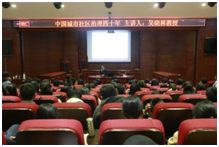
At the beginning of the lecture, Professor Wu introduced the background and process of his research on urban community governance. Combined with his rich experience in practice and profound knowledge, Professor Wu expounded the following themes through pragmatic spirit and full and accurate cases from an international perspective. The themes were as follows: “the historical evolution of Chinese urban community governance, the shaping of models on Chinese urban community governance, the generative logic of community regime, and knowing the organizational logic behind community regime”.
He analyzed deeply the practice violations of grassroots governance, the theoretical dilemmas and solutions of the theory of regime construction and communities, and systemized the development process urban community governance has experienced: from structural reform of “two-level government, three-level management”, partial experiment of “regime and social interaction”, and finally to Chinese models on urban community governance.
He believed that the generative logic of community regime included the dual logic of “regime construction and social construction” within the party construction, the logic of “administrative internalization” for community organization, and the logic of the technical support for community’s administration.
In the interactive section, students asked questions on “whether Utopia or Universal Society could be realized, whether the scope of Chinese urban community governance is comprehensive and how to advance community autonomy.” Professor Wu answered each question in detail. This lecture expanded the academic vision of teachers and students, and stimulated students’ interests in public governance issues. (Text / Peng Xiaxia Photo / Ma Li)