HUTB Team Wins First Prize at 9th China University Intelligent Robot Creative Competition–Chinese College Software Security System Competition
2026-05-28
On May 24, the national final of the Chinese College Software Security System Competition under the 9th China University Intelligent Robot Creative Competition concluded at the University of Science and Technology of China. A team of four junior students from the Cyberspace Security program at the School of Computer Science of the university—Shen Hanshuai, Liu Chao, Liu Shuaiyu, and Deng Haiqiong—secured a national first prize. Only three universities in Hunan, including the National University of Defense Technology, received this honor.
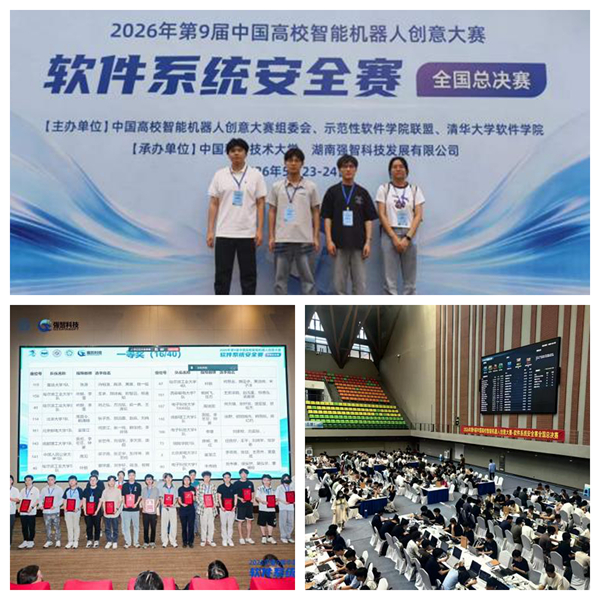
The competition is a Category A discipline competition recognized by the Ministry of Education. It is jointly organized by the Organizing Committee of the China University Intelligent Robot Creative Competition, the Pilot Software Engineering Schools Association, and the School of Software at Tsinghua University, and co-organized by the University of Science and Technology of China and other institutions. This edition of the competition attracted 1,808 teams and 6,195 students from 363 universities nationwide. After three months of rigorous regional preliminaries and on-site contests, only 200 teams advanced to the national finals. The final-round target range featured a wide variety of vulnerabilities and high complexity, posing a severe test to participants’ capabilities in vulnerability discovery, offensive and defensive combat, and system remediation. Facing strong opponents from top universities across the country, the HUTB team precisely overcame challenges in high-intensity offensive and defensive competitions, standing out among numerous powerhouse teams to share the first prize with teams from Peking University, Fudan University, Harbin Institute of Technology, Beijing University of Posts and Telecommunications, and others.
Behind this stellar achievement lies the School of Computer Science’s deep commitment to advancing the “New Engineering” paradigm. Grounded in its mission to build an application-oriented “New Engineering” program, the school has partnered with Professor Zhao Xibin’s team from Tsinghua University and leading university-enterprise collaborators, including China Communications Services Network Security. Together, they have co-developed training programs and core courses, and pioneered the “Manjianghong” Cyber Attack-Defense Team. To tackle the industry-wide talent gap in cybersecurity, the school leverages the team and the DART Platform to build a practice-driven education system. It has established a tiered, closed-loop training model: freshmen focus on foundational skill-building; sophomores and juniors sharpen their abilities through competitions; seniors gain hands-on experience through internships at top enterprises; and a mentorship structure ensures knowledge transfer from experienced members to newcomers. By regularly conducting real-world tasks—such as attack-defense competitions, vulnerability hunting, and cyber defense drills—the school has forged a clear, mature, and highly effective talent cultivation matrix through industry-education integration.
(Reported by Peng Xuhong from the School of Computer Science)