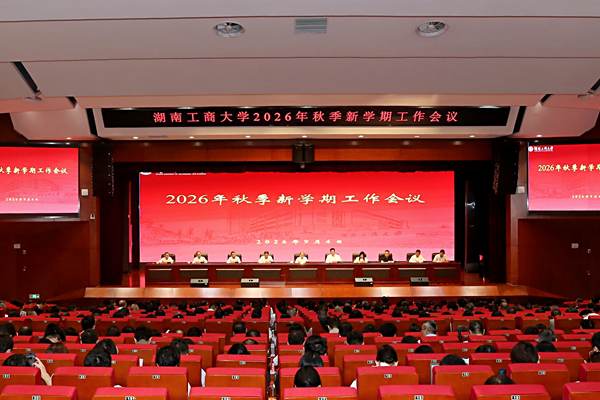
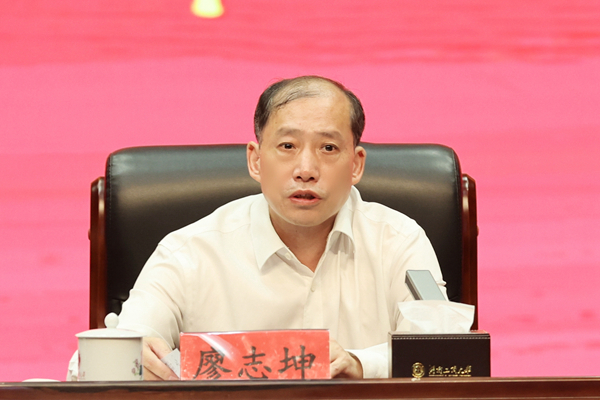
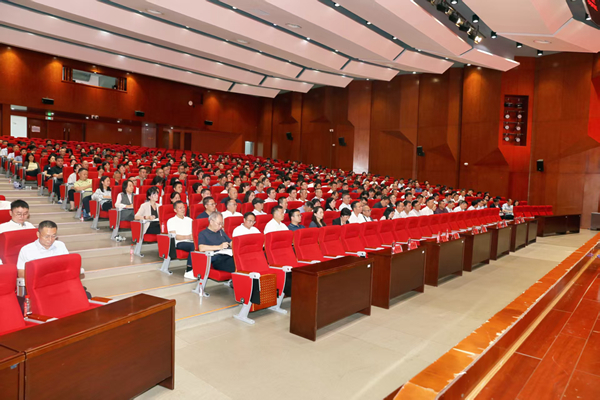
On the morning of September 4, the university's 2026 Fall Semester Work Meeting was held at the Xiangjiang Lecture Hall. Liao Zhikun, Secretary of the CPC HUTB Committee, presided over the meeting and delivered a closing speech. Hou Junjun, Deputy Secretary of the CPC HUTB Committee and President, deployed the work for the new semester. Pan Aimin, Member of the CPC HUTB Committee and Vice President, delivered a special work report. All on-campus Chief Leaders and members of the CPC HUTB Committee attended the meeting.
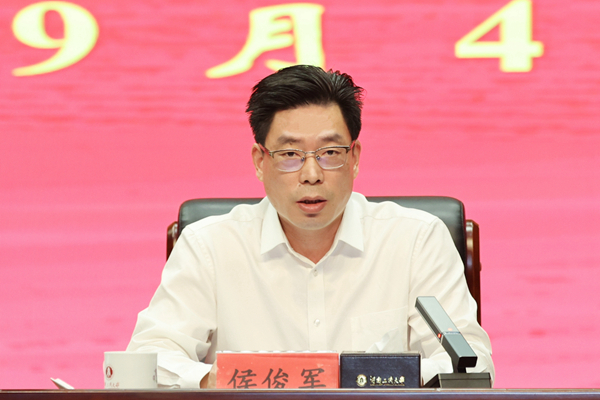
At the meeting, President Hou Junjun delivered a speech titled Standing at a New Starting Point, Seizing New Opportunities, and Making New Achievements. He summarized the university's overall work during the summer and outlined plans for the new semester. He pointed out that facing the highly competitive landscape of higher education, the entire university must anchor itself to the strategic goal of "building a high-quality, distinctive, and high-level application-oriented university of business and commerce." He urged the university to closely follow the main line of the "Double Excellence" project, coordinate development and security, and focus on the following priorities in the new semester: decompose and implement tasks from the university's 15th Five-Year Plan and the report of the Second CPC Congress; clarify the requirements and tasks for building an application-oriented university; strengthen campus culture building to nurture the educational ecosystem with a fine school spirit, teaching style, and study style; deepen connotative development to enhance the quality and effectiveness of talent cultivation; focus on the "primary resource" (talents) to consolidate the foundation for transformation through talent synergy; strengthen strategic support to achieve new leaps in discipline research and high-level platforms; deepen open education to comprehensively improve governance efficiency and smart service levels; consolidate basic guarantees to escort the university's high-quality development with hard-core support; comprehensively enhance the status of secondary schools as the main bodies of running the university and their entrepreneurial vitality.
In his closing speech, Liao pointed out that in the first half of this year, the university carried out the learning campaign on fostering and practicing a correct view of governance performance. It completed the concentrated rectification of problems fed back from the CPC Hunan Provincial Committee inspection, the rectification of problems fed back from the undergraduate education audit and assessment of the Ministry of Education, the formulation of the 15th Five-Year Plan, and institutional staffing, among a series of tasks. The university successfully convened its Second CPC Congress, accomplished all tasks, and maintained stable development.
Liao emphasized that the university's educational goals, development positioning, strategic tasks, and major measures have been set by the 15th Five-Year Plan and the Second CPC Congress. The blueprint has been drawn; the key lies in implementation.
First, focus on goals to ensure implementation. Seizing the opportunity of the state's launch of the “Double Excellence” construction program for high-level application-oriented undergraduate universities, the university must strive to achieve the quality goals of "excellent educational capacity, premium talent cultivation, and outstanding service to regional development," and build a high-quality, distinctive, and high-level application-oriented university of business and commerce.
Second, focus on key priorities to ensure implementation. The university must implement the tasks of the Second CPC HUTB Congress, do a solid job in the "second half" of the CPC Hunan Provincial Committee inspection rectification, and consolidate and expand the achievements of the learning campaign on fostering and practicing a correct view of governance performance. It must vigorously advance the integrated development of education, science and technology, and talent, vigorously promote the construction of disciplines and degree programs, effectively improve the quality of independent talent cultivation, and pool resources in the process of serving the local area.
Third, unite forces to ensure implementation. The university must fully mobilize all favorable factors and positive forces both within and outside the Party and the university to invest in its development, more effectively integrate and utilize off-campus resources, and form a strong synergy for its development.
Fourth, refine responsibilities to ensure implementation. Party members, cadres, teachers, and staff must be mindful of their responsibilities, shoulder them, fulfill them in action, and accomplish them with due diligence. All units must do a solid job in the "second half" of inspection rectification, undergraduate education audit and assessment rectification, and the learning campaign on fostering and practicing a correct view of governance performance. Relevant departments must strengthen supervision over the implementation of the university's central work, the building of a clean and honest Party style and government, work safety, and the performance of duties in ideological work.
Fifth, enhance capabilities to ensure implementation. The university must continuously strengthen the training of officials' political literacy and professional capabilities, focus on improving teachers' teaching and research abilities, continuously work on enhancing the teaching capabilities of ideological and political course teachers, and carry out regular training for counselors' capabilities.
Sixth, strengthen safeguards to ensure implementation. The university must reinforce ideological, safety, disciplinary, and cadre safeguards, and intensify the selection, exchange, rotation, and training of outstanding officials, providing a strong organizational guarantee for its development.
Seventh, keep pace with the times to ensure implementation. The university must proactively adapt to the profound changes in industry, economy, education, and management in the AI era, accurately grasp the general trend of the times, and actively and steadily promote the quality improvement and upgrading of all its work with a proactive and scientific approach to change.
At the meeting, Pan Aimin briefed on the university's employment-entrepreneurship and admissions work. He summarized the achievements in both areas for 2026, analyzed existing shortfalls, and put forward ideas and suggestions for the next phase of work. The briefing noted that in 2026, the university's undergraduate enrollment scale, scores, and rankings rose in sync—with the minimum admission scores for history-track and physics-track applicants ranking 4th and 5th respectively among provincial universities—while the employment situation of the Class of 2026 remained firmly in the top tier among all universities in the province.
All division-level officials, department-level officials, heads of departments (offices), and representatives from various democratic parties attended the meeting.
(Written by Zhang Gaoyang and photo by Tu Hua and Wang Xujun)