First Class from School General Secretary Wang Hanqing for Young Teachers
2016-01-19
On the afternoon of 26th, November, the inauguration of online training courses, themed with “Learning keynotes of President Xi Jinping’s speeches, Striving to be good teachers with four good characteristics in new era,” among young teachers was held in 301 Lecture Hall of No.2 office building. School leaders, Wang Hanqing, Xia Jichun, Peng Qingjin and Liu Guoqua, attended the inauguration ceremony, with teachers under 35 years old from our school presenting the ceremony. This ceremony was presided over by deputy general secretary Xia Jichun. Wang Hanqing gave lecture for the first class, with the theme of “teachers should learn moral cultivation well.”
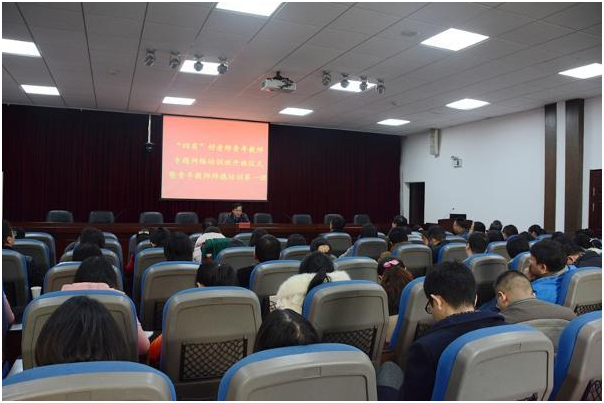
After the opening ceremony, the vice president Peng Qingjin made a brief introduction to the basic conditions of the training course. This training course is jointly held by National Academy of Education Administration and Hunan University of Commerce. It involves two forms: classroom lecturing and online studying. Classroom lecturing includes two lectures from Wang Hanqing and president Chen Xiaohong; online studying involves 57-class-hour long video courses, which are traditional Chinese culture and socialist core values, legal education and teachers’ moral cultivation, teachers’ development and psychological health education, and teachers’ moral cultivation and its typical demonstrations. Wang hoped that all young teachers could conscientiously learn the courses as well as consciously and industriously improve and perfect themselves, enhance individual temperament with “four characteristics” as their standards, so as to be quality teachers for Party and people.
After the inauguration ceremony, Wang Hanqing gave lecture for the first class, with the theme of “teachers should learn moral cultivation well.”His lecture was mainly about the following three aspects: firstly, a full awareness of the importance in enhancing young teachers’ moral cultivation; secondly, the current prominent problems in young teachers’ moral cultivation; thirdly, several wishes for young teachers in moral cultivation.
Combining his own practical working experience in Hunan University, Nanhua University, Hunan Poly-technical University and Hunan University of Commerce, Wang Hanqing explained his understanding about teacher and teachers’ moral cultivation. He emphasized, enhancing young teachers’ moral cultivation is the inevitable demand of overall implementation of Party’s education policies and of ensuring universities to adhere to socialist education orientation, the fundamental efforts in improving professional literacy, facilitating career development and promoting senses of satisfaction and happiness from career, as well as the pressing demand of our school’s strategic objectives of implementing “strengthening school through talents” policy and realizing “three upgrades and three prospering.”
Wang hanqing, with his rich educational management experience in university, analyzed the prominent problems and named their corresponding behaviors in young teachers’ moral cultivation from the real cases, striking a chord with all the present young teachers.
At last, Wang Hanqing sent his words to those young teachers. Firstly, young teachers should firmly keep their faith with high aspirations; secondly, young teachers should impart knowledge and educate people with passion for their job; thirdly, young teachers should care and love students with dedication to students and the career. Wang hopes that all young teachers bear President Xi Jingping’s earnest words in their mind, strive to reach the “three highs”-high spirits in loving the career, high level in educating students, high standards in serving as a role model for students, and seek to be good teachers with “four characteristics”-teachers with dream and faith, teachers with morality and temperament, teachers with solid academic foundation, teacher with love and kindness. Wang added that, young teachers should devote themselves to teaching and educating students, fulfill their duties and make their contribution to the realization “Three Upgrades and Three Prosperities.”
(Editor: Hu Huimei)